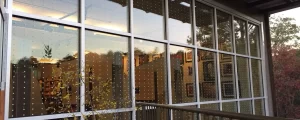
Approximately one billion birds die annually from building collisions in the U.S., many due to nocturnal migration disorientation.
Most birds migrate at night and can be disoriented by bright artificial lights and skyglow from urban areas, often causing them to collide with buildings or windows, or exhaust themselves circling bright city lights.
Lights Out:
Our region lies directly along the Atlantic Flyway, used by millions of birds every year to migrate in the spring and fall. Lights Out is a voluntary, national program that encourages homeowners and building managers to reduce external and internal lighting as much as possible to help migrating birds.
Participating is simple to do at home and for businesses, and often has secondary benefits for other wildlife, reducing light pollution, reducing energy costs, and reducing the region’s overall carbon footprint.
What You Can Do:
YOU can help make Virginia safer for migrating birds by adjusting, reducing or eliminating outdoor lighting during peak bird migration. Here are some actions you can take:
At home:
- Turn off exterior decorative lighting where possible
- Point floodlights down, or shield them to reduce horizontal glare
- Close curtains or blinds, if available
- Install motion sensor lighting where possible
- Use warmer lighting (more orange-yellow instead of white-blue)
At your workplace:
- Reduce lobby and atrium lighting where possible
- Extinguish spot and flood-lights where possible
- Remind employees to switch lights off when leaving the office.
- Instruct evening cleaning crews to make turning off any office lights part of their to-do list
- Turn off interior lighting, especially on upper floors
- Substitute task and area lighting for workers staying late
- Down-shield exterior lighting or limit to ground level
Peak spring migration: March 15 – May 31
Peak fall migration: August 15 – November 15
FAQs
Are other cities participating?
Lights Out is a national program with more than 32 participating cities including Hampton Roads, Washington DC, Baltimore, Philadelphia, New York, and Boston Raleigh, Greensboro, Winston-Salem, Charlotte, Dallas and many more.
Do I need to turn off all my interior lights?
No, however please turn off unnecessary and unused lighting, especially those that are closest to windows, from 11 p.m. to 6 a.m. or use task lighting. If you are unable to turn off interior lights, draw window blinds, shades, drapes, or window coverings.
Lights Out, Piedmont! is an outreach campaign of Dark Skies Piedmont. Piedmont Virginia Bird Club is sharing this information for educational purposes.
Learn more about the national Lights Out Program on Audubon’s website.
Other Ways to Help Birds:
While the hazards of tall buildings and urban lighting poses a severe risk to migrating birds, millions of more birds die every year around residential homes, including one-story structures, due to window strikes and other causes. Here are some more steps you can take to help birds.
1. Make windows safer for birds:
- Create patterns on windows, especially windows that face large open green spaces, using stickers or etching, or even cords. This breaks up the reflective glass surface and gives birds visual cues that the way is not clear; the quantity and spacing of the patterns determine their
effectiveness: multiple markings 2 to 4 inches apart are recommended.- Install external screens on windows.
- Close blinds and curtains whenever possible.
- Don’t place plants near windows.
- Prioritize windows near feeders for safety improvements.
Vinyl dots on windows at Chattahoochee Nature Center Photo: Adam Betuel
More info from the Cornell Lab of Ornithology
And Audubon.2. Create habitats:
- Install native plants to provide natural sources of nectar, seeds and fruit, and support robust insect biodiversity. Insects provide
essential protein for birds, especially during the nesting season.- If you have space, leave a wood pile. This provides great habitat for a variety of birds and other
wildlife.- Let your yard get a little messy; leaf litter and ground cover provide important habitat for ground foraging birds.
- Standing dead trees and tree stumps offer critical foraging space and even home for woodpeckers, nuthatches, and many other birds. Consider leaving these if they don’t pose a safety threat.
- Install nest boxes with proper placement and safeguards from predators and invasive bird species.
Find native plants for your area from the Virginia Native Plant Society.
Tips for nesting boxes from the Virginia Grassland Birds Initiative.3. Follow bird feeder best practices:
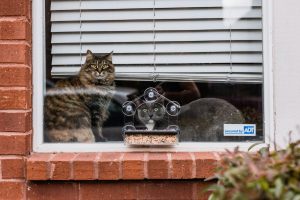
- Feeders should either be within 3 feet of windows or more than 20 feet to give birds the best chance of reacting and surviving impacts. Feeders that attach to windows are generally safe.
- Place feeders about ten feet from shelters (evergreen shrubs and brush piles work best) so birds can escape predators, but squirrels and cats cannot use them to access feeders and birds.
- Clean and sanitize feeders and baths at least every two weeks to prevent disease spread. Scrub off any visible debris, then wash them with nine parts water to one part bleach. Let dry before filling with seed.
- Hummingbird feeders should be placed in locations sheltered from wind and sun. Sugar water should be replaced every three days, or daily if temperatures exceed 80 degrees. Scrub the feeder with warm water and a brush when replacing sugar water. Don’t add dye to sugar water.
Get more guidance from Audubon.
4. Keep cats indoors:
- Studies unequivocally show domestic cats are a major threat to birds, with many estimating cats kill more than a billion wild birds in the U.S. every year.
- Keeping cats indoors or confined to enclosed “catios” keeps birds and other wildlife safe and also gives the cat a healthier and longer life.
- Spay or neuter your pet. Cats can get pregnant as young as 4 months old and have multiple litters per year, which can result in runaway feral cat populations in areas.
More information from the Wildlife Center of Virginia.
5. Limit chemical usage
- Reduce usage of fertilizers, which have been found to reduce biodiversity by promoting fast-growing species that outcompete native plants, disrupting reproductive cycles, and introducing toxic chemicals like PFAS into ecosystems.
- Applying pesticides to your property can harm beneficial wildlife, including birds directly, or indirectly by harming beneficial insects.
- Herbicides are a useful tool, especially for dealing with invasive plants. Use judiciously and always follow label instructions for safe, correct use; it’s the law.
- Dispose of chemicals properly, either following guidance on labels or from local officials.
More tips from the US EPA.